
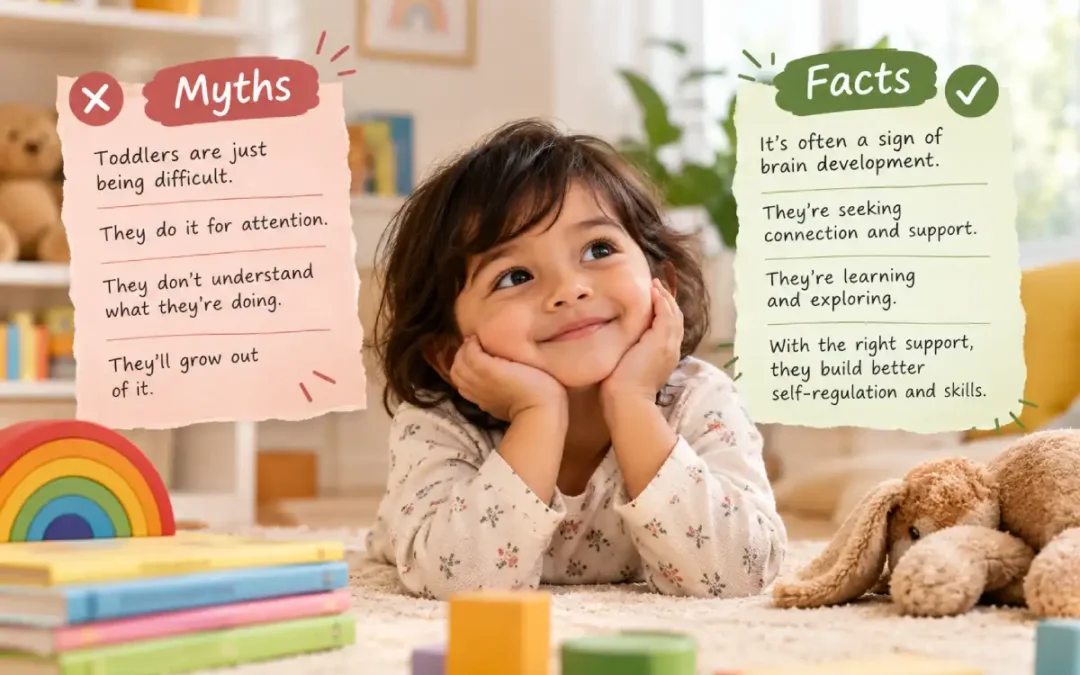
Parenting a toddler comes with countless learning experiences, unexpected challenges, and moments that test patience. From sharing toys and managing tantrums to following instructions and learning new words, toddlers are constantly discovering how the world works. However, many behaviours that adults consider stubborn, difficult, or inappropriate are actually a natural part of early childhood development.
During the toddler years, a child’s brain is developing rapidly. They are learning to understand emotions, communicate their needs, interact with others, and gradually develop independence. However, these abilities do not develop overnight. They require time, patience, guidance, and meaningful experiences.
1. Myth: Forcing a 2-Year-Old to Share Teaches Empathy and Social Generosity
Fact: Empathy and Perspective-Taking Develop Gradually Around Ages 4 to 5
Sharing is often considered an important social skill, and parents naturally want their children to learn kindness and generosity. However, expecting a two-year-old to understand sharing in the same way as an older child may be unrealistic.
At this age, toddlers are still developing their understanding of ownership, emotions, and other people’s perspectives. The ability to recognise that another person may have different feelings, thoughts, or needs develops gradually.
When adults force toddlers to hand over a favourite toy before they understand the concept of ownership and turn-taking, the experience may create frustration rather than genuine generosity.
Instead of demanding immediate sharing, parents can introduce simple activities that encourage cooperation and patience.
2. Myth: A Screaming Child Is Trying to Manipulate You and Needs Immediate Discipline
Fact: During a Meltdown, Emotional Responses Can Overwhelm a Toddler’s Developing Self-Regulation Skills
Toddler tantrums are among the most challenging experiences for parents. A child may suddenly start crying, screaming, throwing toys, or refusing to cooperate over something that appears insignificant to an adult.
It is easy to assume that such behaviour is intentional manipulation or a deliberate attempt to get attention. However, young children are still developing the ability to understand and regulate their emotions.
During a meltdown, the emotional systems of the brain can become highly activated, making it difficult for toddlers to use developing reasoning and self-regulation skills. Their nervous system may enter a heightened stress response, and they may struggle to process instructions or explanations.
This is why lengthy lectures or immediate punishment during an emotional outburst are often ineffective.
Instead, parents should focus on helping children feel safe and gradually regain emotional control.
3. Myth: A Toddler Who Sits Quietly and Always Follows Instructions Has Better Self-Control
Fact: True Self-Regulation Develops Through Exploration, Practice, and Guidance
Many parents and caregivers associate quiet behaviour and immediate obedience with good discipline. A toddler who sits quietly, follows instructions, and rarely challenges boundaries may appear more well-behaved than an active child who constantly explores their surroundings.
However, compliance and self-regulation are not the same thing.
Self-regulation is the developing ability to manage emotions, control impulses, adjust behaviour, and respond appropriately to different situations. These abilities take time to develop and are influenced by a child’s age, experiences, environment, and emotional development.
Toddlers naturally learn through exploration. They touch objects, ask questions, test boundaries, move around, and sometimes express strong emotions. These behaviours are part of how they discover their environment and understand what is expected of them.
4. Myth: Educational Apps and Videos Speed Up Language Development
Fact: Young Brains Need Active Interaction and Eye-to-Eye Human Conversations to Develop Language Skills
Technology has become a common part of modern childhood. From educational videos and animated alphabets to interactive learning applications, parents have access to countless digital resources designed to introduce children to new concepts.
While some educational content can provide exposure to words, sounds, and visuals, passive screen viewing cannot replace meaningful conversations and real-life interactions.
Language development involves much more than hearing words. Toddlers learn communication through listening, observing facial expressions, responding to voices, imitating sounds, and participating in conversations.
For example, when a parent points towards a bird and says, “Look at the bird!”, the child experiences a meaningful interaction. They can observe the object, hear the word, follow the parent’s gesture, and respond through sounds or expressions.
Nurturing Young Minds Through Understanding and Positive Parenting
Raising a toddler is not about creating perfect behaviour but about understanding the developmental needs behind everyday actions. From learning to share and managing emotional outbursts to developing self-control and communication skills, every experience contributes to a child’s growth.
Parents play an important role in creating an environment where children feel safe to explore, express themselves, make mistakes, and learn. By replacing common parenting myths with developmentally appropriate practices, caregivers can support healthier emotional, social, and cognitive development.
At Kookaburra, we believe that every child deserves an environment that encourages curiosity, exploration, meaningful interactions, and independent learning. Understanding how young minds develop allows parents and educators to nurture children with greater patience, empathy, and confidence.